Chasing Next
Explore Lessons
BlogFor TeamsAbout
Log inWork with meStart for Free
All posts
May 26, 2026·4 min read

How 10% of marketing teams are pulling ahead with AI

While most teams are waiting for someone to figure it out, the top 10% aren't.

RileyRiley Beresini
How 10% of marketing teams are pulling ahead with AI

For the last three months, I've been on calls with marketers about how they're using AI. Most teams are stuck. Only 10% have a handle on it.

Last week I wrote up 17 things I heard across those calls. The natural follow-up: what are the 10% doing differently?

My honest answer: there was a manager who stopped waiting and took the lead.

Instead of deferring to L&D, IT, the AI task force, or a consultant to figure it out, they decided to be the one.

Here's what they did:

1. They actually use AI in their work

This one sounds like a no-brainer. By using AI, I don't mean chatting with it to finish your deliverable. I'm talking about coming up with specific ways to use it that help your work repeatedly. And most importantly, sharing those with your team. 

One manager built deep research into their campaign strategy process, then validated and reconciled it against internal data. Instead of telling the team to use it and figure out how, they showed how they were using it and set an expectation that they do too. 

The reality is most managers aren't walking the walk. They're leading AI adoption by mandate: get the team through training, tell them to use the tools, then wait for someone to tell them what's working. 

If you're not using it yourself, why should the team? The 10% managers are figuring out the path.

2. They make their team want to share

Getting your team to share is the easy part. Just ask Scott to talk about AI at the quarterly all-hands or have Tina build a slide for the team meeting no one's paying attention to. 

Making them want to share is much harder. To get there, you have to build
 momentum by recognizing people, celebrating them, and making messy work welcome. 


The orgs I'd put in the 10% are naturally having conversations. Some even have Slack channels people want to be a part of. They're sharing a new tool they heard about, personal workflows, half-baked experiments, and questions for others. They're seeing how AI has helped others get ahead and want in on it for themselves. 

I'm not saying you need to start a Slack channel to be a 10% manager. The aim is making "figuring it out together" your team's culture. Recognize people trying things, thinking out of the box, getting curious, and asking questions. Make others want in by celebrating the mess, not just the wins. This only works when sharing feels genuine, not required. 

Compare that to teams running scheduled AI meetings that fizzle, or ones where teammates are gatekeeping prompts because it's their edge. 

What cues are you sending your team? The 10% managers are making it safe to learn in public. 

3. They push for tool access

Most managers default to whatever AI tools their org rolled out and tell the team to make it work. Pushing for more usually means going to bat with IT or security, and most don't have the energy.

The 10% managers push anyway. They advocate for access to tools that will help their team. Or even better: a stipend program. 

I heard a few companies doing this. One where people could request a tool, get reimbursed, and share what they learned. Another that gave each person a $250 AI budget for tools and training. 

You might be thinking, "this will never work. What about privacy?" 

The case is something like this: people are already using unapproved tools, sometimes even paying out of pocket. This is going to keep happening, with or without rules. Better to make it official and learn what's working than lock everything down and pretend it's not happening.

The worst version is don't-ask-don't-tell. It teaches the team to hide what's going on and kills the sharing culture you're trying to build.

Do you know what tools your team is using? The 10% managers do, and they fought for them.

4. They give their team time to rethink the work

Most managers tell their team to use AI and keep every deadline exactly the same. They think: AI is supposed to speed you up, not slow you down. 

Transformation takes reimagining how work gets done. Reimagining takes time, and it takes someone owning it. Without both, you get band-aid use.

The 10% managers know this. They let some projects take longer up front and put their team on the hook to come back with something reusable.
 There's an expectation that some work is going to be slower and rougher so it can be faster and smoother later.

Are you giving your team time to rethink their work? The 10% managers are.

Don't wait to be told

If you want to figure it out, you have to lean in.

Even the teams I'd put in the 10% don't feel like they have it figured out. None of them are walking around feeling confident. 

They're just as busy as you, just as unsure. They're further along because they stopped waiting. 

That's the whole thing. The 10% is the decision to take the lead.

Hit reply and tell me which one landed or what's worked for you. 

Riley

Written by Riley Beresini

After a decade doing marketing strategy and driving digital innovation for Disney Parks and Macy's, I started helping teams figure out AI. I began Chasing Next as a newsletter on AI adoption two years ago, and it's grown into interactive, personalized training. Here I share the best of what I learn to help you get ahead.

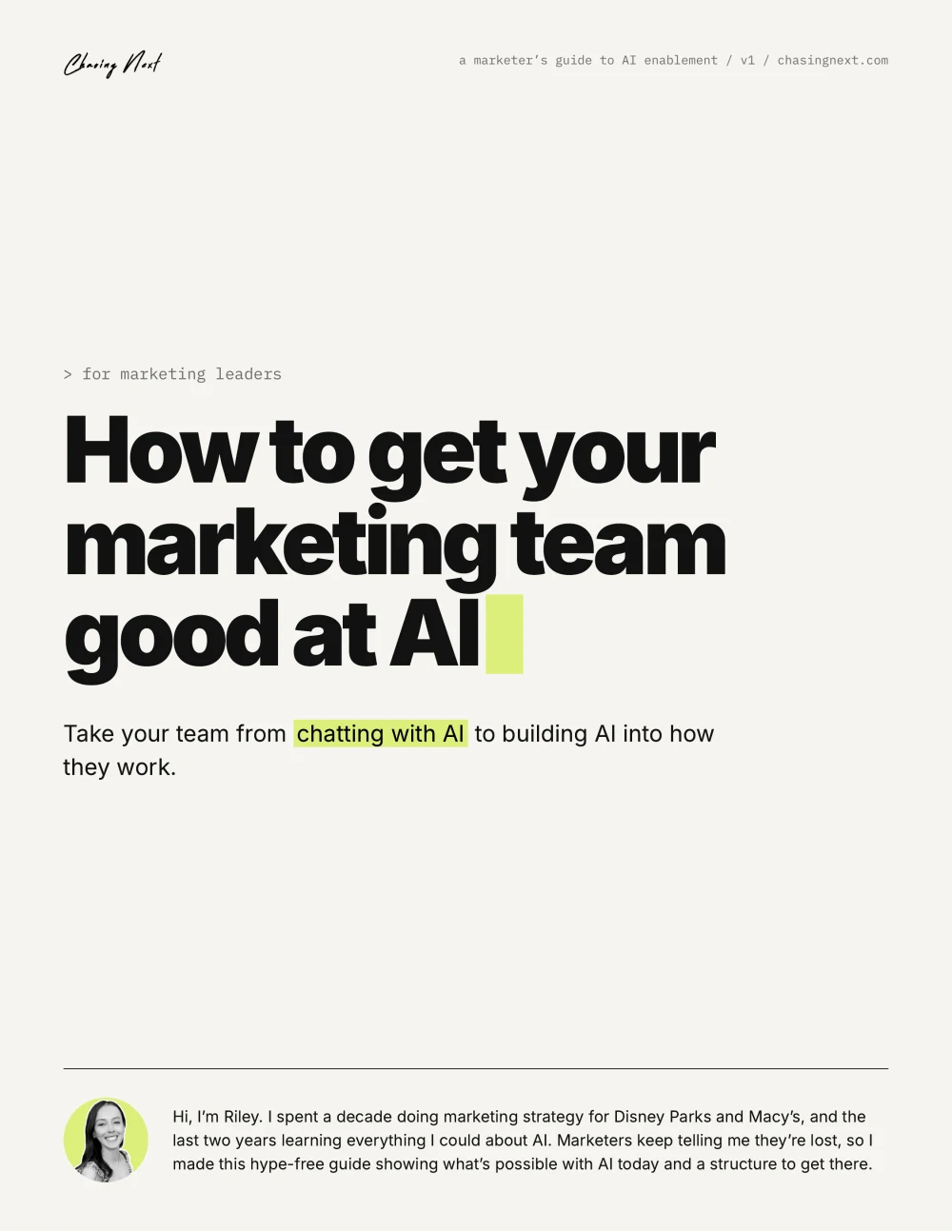
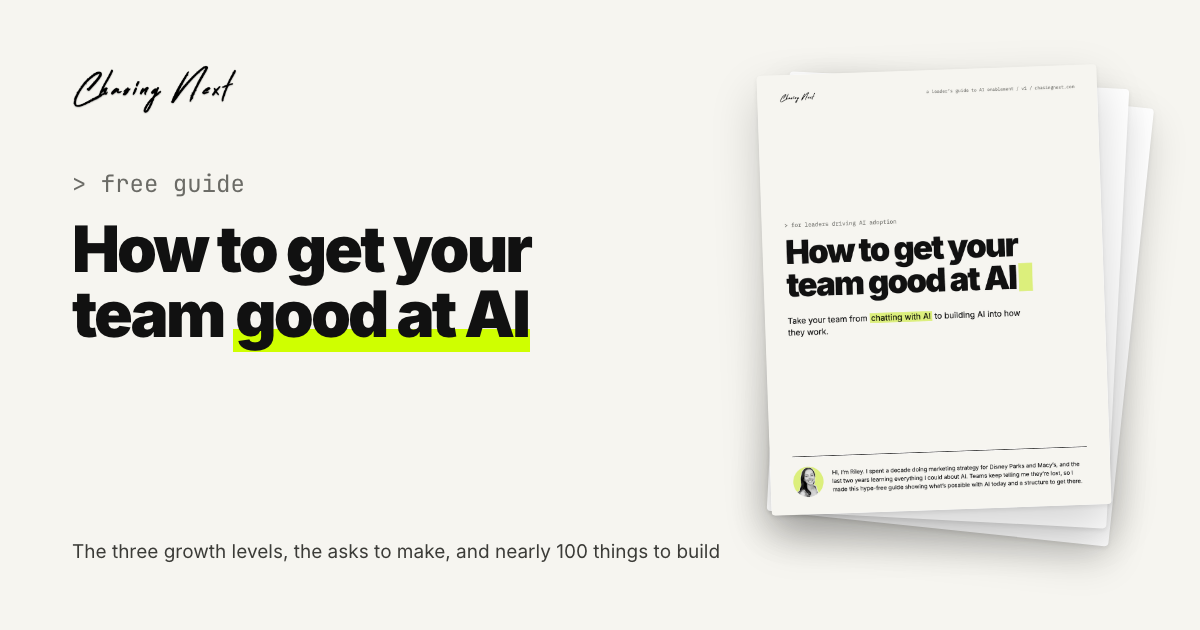
Cover of the guide How to get your marketing team good at AI

Get your marketing team good at AI.

The three levels it takes, the asks to make upward, and nearly 100 things to build. Free guide.

By requesting the guide, you agree to our Terms. See our Privacy Policy.

Continue reading

What execs never hear about AI

What execs never hear about AI

What should I do with AI?

What should I do with AI?

How to get your team good at AI (free guide)

How to get your team good at AI (free guide)

Chasing Next

Learn AI by doing.

Start for FreeFor TeamsWork with meFree AI GuideAboutFAQUpdatesBlog
Sign UpSign InSupport
2026 Moonswell Marketing LLC·Terms·Privacy··