Listen up.
You're sitting there, typing another quick prompt.
"Build me a marketing strategy for our new product."
Hit enter.
What comes back?
Generic slop.
Sounds like AI wrote it, not you.
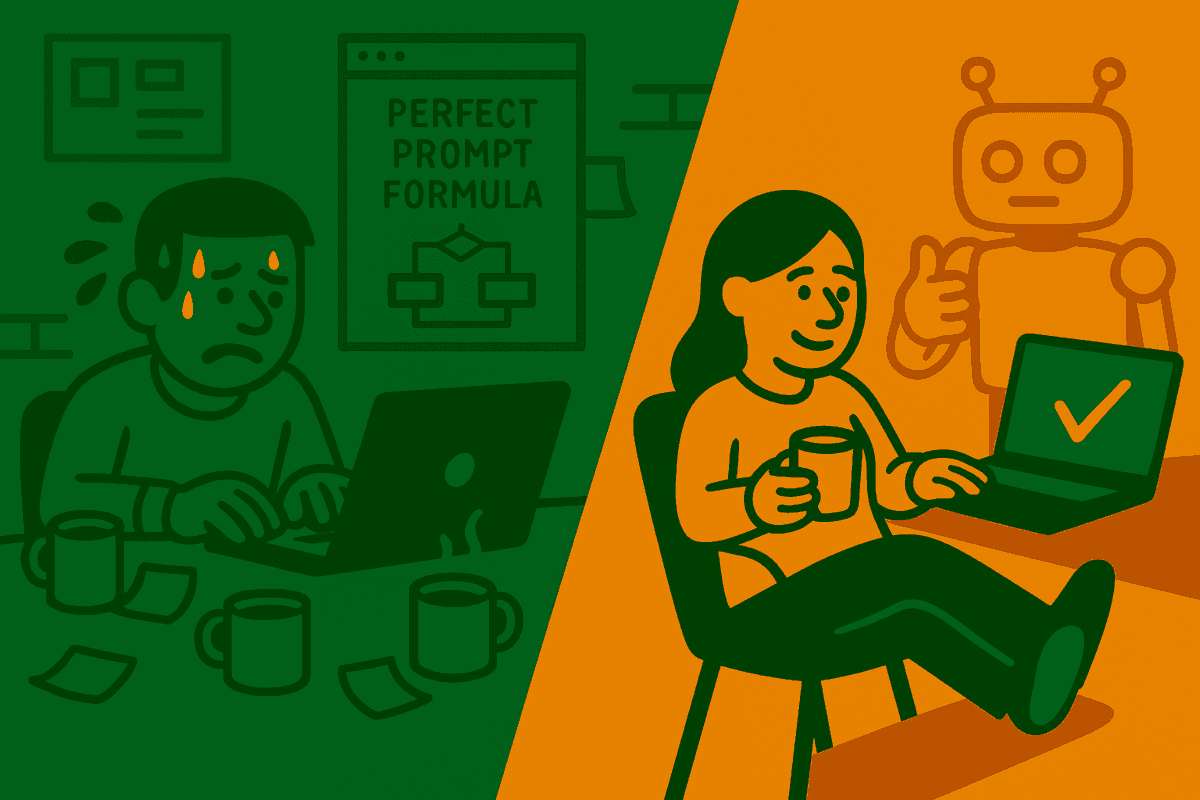
You remember all that prompt engineering training.
The multi-step strategies. The persona matrices. The tone guides.
You feel guilty you're not using any of that.
But here's the truth:
You don't have time for that, and you don't need to.
Just learn to be strategically lazy instead.
The Prompt Spectrum: Lazy vs Precise
Most AI training makes you feel like you need a PhD to write a good prompt.
Total nonsense.
Here's the deal...
You have my permission to be lazy 90% of the time.
But, we're going to take you from lazy bad to lazy good.

Lazy Prompts — 90% of Interactions
Be lazy when you need:
- Quick answers
- Basic guidance
- Simple instructions or outputs
- Surface-level information
Precision Prompts — 10% of Interactions
Be precise when you need:
- To solve complex problems
- To create repeatable processes
- To conduct deep research or analysis
- To generate truly unique or custom results
Most interactions should be quick and simple.
The other 10%?
That's where you spend time creating precision prompts that do heavy lifting.
From Lazy Bad to Lazy Good: 4 Upgrades That Take Seconds
1. Add Just Enough Background Info
Bad lazy is providing zero context.
Big mistake. Context turns generic into personalized.
2. Give AI a Personality
If you don't give AI perspective, it defaults to drab.
Getting creative with it's personality gives you rich responses.
3. Have AI Be Your Amplifier
AI returns slop when you don't share your POV.
Go beyond that by using AI to expand and showcase your thinking.
4. Give AI a Clear Goal
What exactly do you want AI to achieve?
Make sure it knows this.
4 Questions Lazy Good Prompters Ask:
- What specific context transforms this from generic to specific?
- Whose perspective would make this response valuable?
- How can AI help me challenge and expand my thinking?
- What's the specific outcome I'm trying to achieve?
This Prompt Takes You From Lazy Bad to Lazy Good
Get lazy good prompts without effort by running this prompt:
Lazy Prompt Transformer:
1. Enter your vague, unpolished prompt
2. We turn it into a powerful interaction by:
- Clarifying the exact goal
- Adding critical context
- Defining a sharp perspective
- Challenging initial assumptions
3. Enter your new lazy good prompt into a new chat window
Result: From lazy bad to lazy good.
Transform your lazy prompts in seconds
Get the Full Prompt →Good Lazy is Leverage.
Despite what training teaches you...
You don't need to spend 60 minutes crafting the perfect prompt.
Just take 60 seconds to add the right details.
That's the difference between lazy bad and lazy good.
Save precision for the 10% that needs it.
Everything else?
Stay lazy, but get specific.