Stripe and Amazon just posted jobs for a role that didn't exist last year.
They're hiring Forward Deployed Marketers. Almost nobody has the skills for it yet, which is exactly why now is the time to get them. |
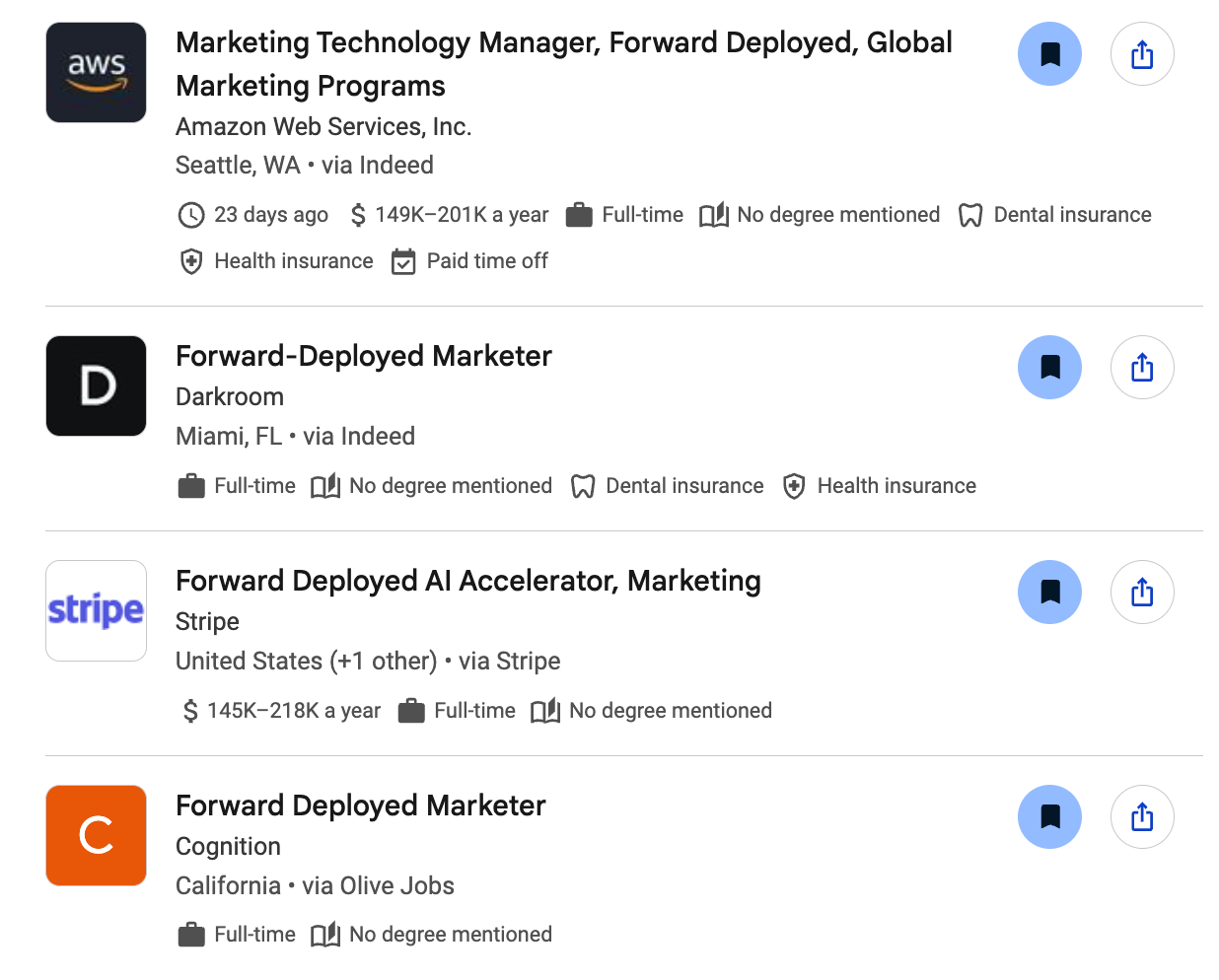 Google Jobs: Forward Deployed Marketer |
To understand why, you have to look at the role it's copied from. |
What is a Forward Deployed Engineer?
|
Forward Deployed Engineer postings jumped 729% between April 2025 and April 2026 (AOL).
The reason is unflattering. A widely circulated 2025 study found 95% of enterprise AI pilots had no impact on P&L (MIT NANDA).
Organizations couldn't make AI work on their own, so AI companies started placing their own engineers inside customer organizations to do it for them.
It worked well enough that EY, Deloitte and PwC now hire Forward Deployed Engineers too. |
The Forward Deployed Marketer is next
|
Amazon's job listing says their role is "modeled after the Forward Deployed Engineer concept." They're embedded with teams, watching pain points in real time, then prototyping the fixes themselves.
Stripe is blunter. Their marketers are already "building their own data dashboards, creating agents that compress multi-day processes, and authoring tools that accelerate workflows." So they've built a role to match.
These five skills will get you one of those jobs: |
1. Know your company's data and spot where it can work harder
|
Your company has more data than anyone uses. Most of it gets looked at in a silo by the team that owns it, so no one catches how one area affects or could strengthen another.
Imagine your ads talk about the speed of your service, but your customer surveys say trust is what's been winning their business lately. The language that converts is sitting with the Insights team instead of being compared to your ad copy. Pull them together and your messaging starts coming from what customers say.
The skill is spotting what's out there and what's worth pulling together.
Try this: List the platforms your company uses and what types of data each one holds. Then write down what you'd gain if they could talk to each other. |
2. Connect data to AI with APIs, CLIs and MCPs
|
Most marketers feed AI by dragging CSVs, PDFs, and screenshots into a chat window. It works for a one-off, but it's manual and there's nothing left to reuse next time.
APIs, CLIs and MCPs connect your data to AI directly. Once it's flowing you can ask questions about live numbers, build your own dashboards, and set up automations that watch it for you. Most platforms you already pay for have them, including Google Ads, Analytics, Search Console, Meta, TikTok, Salesforce, HubSpot, Klaviyo and Ahrefs.
We've all worked on the monthly report that pulls from four platforms owned by four different people and takes days to assemble. Now you can feed the data to AI and have it build the first pass for you.
Try this: Find out which connections your company already allows and ask AI for something you'd normally pull a report for. If nothing's connected yet, look up whether your main platforms offer one and who you'd need to ask to set it up. |
3. Handle security and permissions without being a risk
|
This is what decides whether you get to be a Forward Deployed Marketer. You can be the most cracked AI builder on your team, but only people who can be trusted with company data will get near it.
Things to learn: - How to store API, CLI, and MCP credentials
- The difference between read and write permissions
- How to set up spend caps so you don't run up a surprise bill
Say you want AI reading your sales data to find patterns, but some of it has names and email addresses in it. Show your team the care you take to strip that out, and that you consistently follow company policy. Then trust will follow.
Try this: Find out what your company's rules are for what data can and can't go into AI, and who owns it. If there's no policy yet, be the person who flags that.
|
4. Let AI write the code
|
Building is the part that historically belonged to another team. You describe what you want, then wait... if it even made their to-do list.
Now, with the right access, a marketer can build their own tools by using AI to code. Think custom dashboards, tasks that run on a schedule, automated reports, and small tools for the thing you keep doing manually. This doesn't replace engineers. It frees them up for more complex work, while you create stuff they were never going to.
Since you're leaning on AI to code, you'll want to work where it codes best. Today that means getting comfortable with Claude Code or Codex. Tomorrow it could be something else.
Try this: Have AI build you one small tool for something you redo by hand every week. Something you can run again next week and get the same value from. |
5. Maintain what you build
|
Keeping tools running is the unglamorous part, but it decides if anyone trusts your stuff.
Credentials expire, new models come out, and edge cases pop up. Suddenly something that ran fine for months stops working without telling you.
Sometimes it's obvious, like a weekly report that stops delivering. But others it's quiet, like an output that drifts or gets sloppy when a model changes. Once you're building and sharing tools, keeping them working falls on you.
Try this: Run a prompt, project, or skill you've used before and see if it still holds up. If it's slipped, tweak the instructions until the output is back to your standard. |
None of these are marketing skills
|
They're the skills of people you file tickets with and hand off builds to. But pick them up and you can amplify your marketing knowledge in a way the person building your tools can't.
That's exactly what companies will reward you for.
Barely anyone has all five yet. Start with one and grow from there.
-Riley
PS - Want a first move? These free modules help you build reusable tools for your work: chasingnext.com/start |